
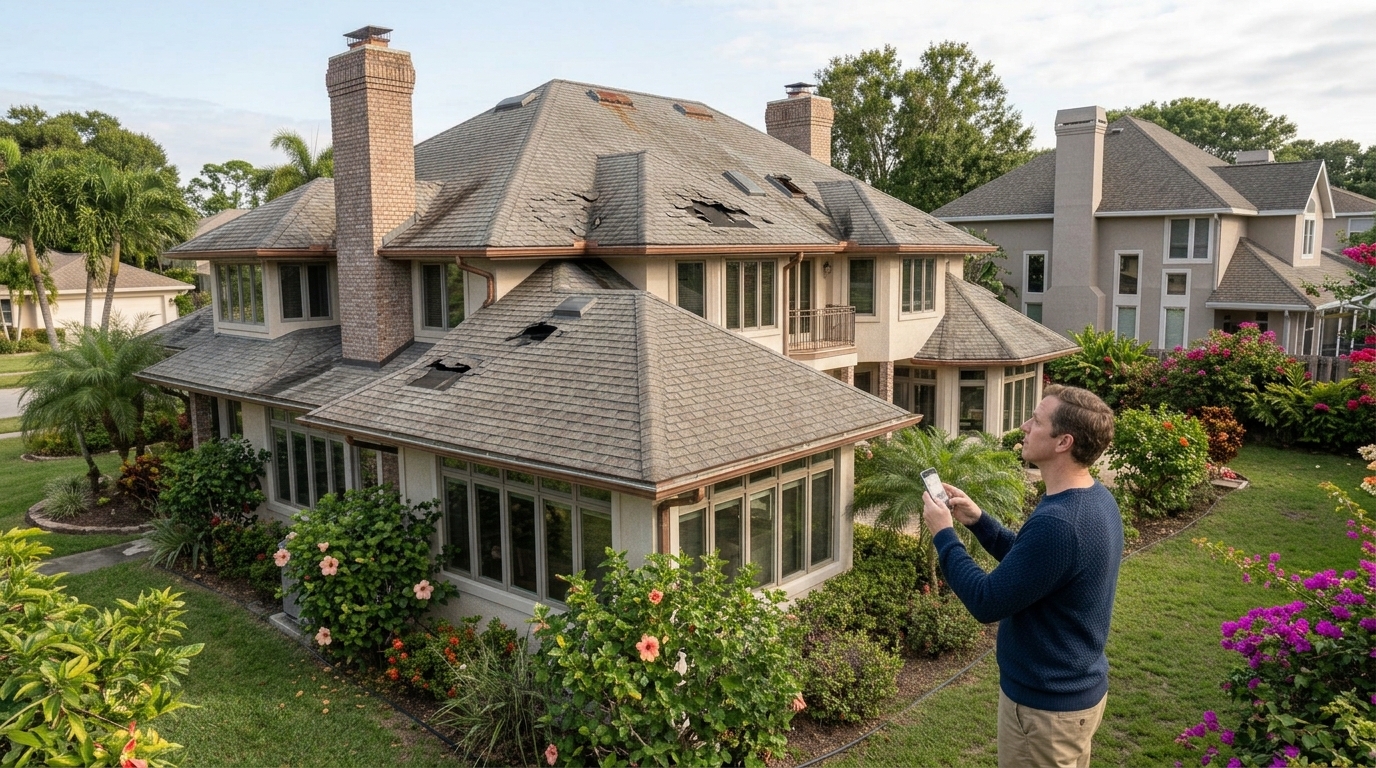
A roof doesn’t usually fail all at once.
More often, it gives you warning signs first: shingles start deteriorating, leaks become more frequent, flashing fails, or large areas of the roof begin showing visible wear.
The challenge is knowing when you’re looking at a roof that needs a repair versus a roof that’s approaching the point where replacement makes more sense.
Here are 10 signs that your roof may be nearing the end of its useful life.
1. Your roof is near the end of its expected lifespan
Age alone doesn’t mean you need a new roof.
But it is an important factor.
Typical asphalt-shingle roof lifespans can vary substantially depending on the shingle type, installation, climate, maintenance, and weather exposure.
As a general starting point:
- Basic 3-tab shingles often have shorter expected lives.
- Architectural shingles generally last longer.
- Premium products may have longer expected service lives.
If your roof is approaching or exceeding its expected service life and you’re seeing other signs of deterioration, replacement becomes more worth considering.
The key is to look at age and condition together.
2. You have recurring leaks
One isolated leak doesn’t necessarily mean you need a new roof.
A damaged shingle, flashing problem, or roof penetration may be repairable.
Recurring leaks are different.
If you’ve had multiple leaks in different areas of the roof, that may indicate broader deterioration.
Ask the roofer:
“Are these separate localized problems, or are they signs that the roof system is deteriorating?”
That distinction can save you from repeatedly paying for repairs on a roof that’s nearing the end of its useful life.
3. Shingles are curling or buckling
Look at the shingles from the ground.
Widespread:
- Curling
- Buckling
- Distortion
- Raised edges
can indicate significant deterioration.
One damaged shingle isn’t the same as widespread curling across a roof slope.
If you see extensive curling or buckling, have the roof professionally evaluated.
4. You see widespread granule loss
Asphalt shingles are covered with mineral granules that help protect the roofing material.
Some loose granules are normal, especially on newer shingles.
But substantial granule loss on an aging roof can be a sign that the shingles are deteriorating.
Check your gutters and downspouts for unusual accumulations of roofing granules.
If you’re seeing significant loss across the roof, ask a roofer to assess the shingles.
5. Many shingles are missing or damaged
A few missing shingles after a storm may be a straightforward repair.
A roof with widespread missing, cracked, broken, or damaged shingles is a different situation.
Look for:
- Missing shingles
- Cracked shingles
- Broken tabs
- Exposed underlayment
- Large areas of storm damage
If damage is widespread, ask whether repairing individual sections still makes economic sense.
6. Your roof is visibly sagging
A sagging roof is more serious than normal shingle wear.
It can indicate moisture damage, structural problems, or other issues affecting the roof system.
If you notice a significant sag:
Don’t climb onto the roof to investigate it yourself.
Have the area evaluated by a qualified professional.
If the sagging is severe or appears to threaten the ceiling or structure below, keep people away from the affected area and seek professional assistance promptly.
7. Flashing is deteriorating
Flashing helps protect vulnerable areas where water could otherwise enter.
It may be installed around:
- Chimneys
- Skylights
- Roof valleys
- Roof-to-wall intersections
- Vents
- Other penetrations
Deteriorated flashing can cause leaks even when the shingles themselves still look reasonable.
This doesn’t automatically mean the entire roof needs replacement.
But widespread flashing problems combined with an aging roof can be an important warning sign.
8. You can see daylight through the roof
If you’re safely inspecting an accessible attic and can see daylight through areas where there shouldn’t be openings, that’s a reason for further investigation.
Possible explanations include:
- Roofing damage
- Gaps around penetrations
- Missing materials
- Installation problems
Not every visible ray of light in an attic means the roof needs replacement.
Some roof ventilation systems are intentionally designed to allow airflow.
But unexplained openings or daylight accompanied by moisture, damaged decking, or other signs of deterioration deserve attention.
9. Your roof has widespread moss or biological growth
Moss can retain moisture and may contribute to deterioration when it becomes established on roofing materials.
A small amount of growth doesn’t automatically mean the roof needs replacement.
But widespread growth, particularly when combined with aging shingles and other deterioration, is worth having evaluated.
Don’t aggressively scrape or pressure-wash asphalt shingles.
That can cause additional damage.
10. Repairs are becoming frequent and expensive
This may be one of the most useful signs from a homeowner’s perspective.
Imagine you’ve repaired:
- One leak this year
- Another leak next year
- Several damaged shingles afterward
- Flashing a few months later
At some point, the question changes from:
“Can this problem be repaired?”
to:
“Does continuing to repair this roof still make financial sense?”
A roof doesn’t need to be completely failed before replacement becomes the more practical option.
A single warning sign doesn’t automatically mean replacement
This is important.
Seeing one cracked shingle doesn’t mean you need a new roof.
Finding a small leak doesn’t necessarily mean you need a new roof.
Even an older roof may still have useful life remaining.
Replacement becomes more compelling when multiple indicators appear together.
For example:
20-year-old roof + widespread curling + significant granule loss + recurring leaks
is a much stronger replacement case than:
10-year-old roof + one damaged shingle
Context matters.
How to tell repair from replacement
When evaluating the roof, consider four things:
1. Extent of damage
Is the problem confined to one small area?
Or is deterioration visible across multiple roof sections?
2. Roof age
How old is the roof compared with the expected life of its specific roofing materials?
3. Repair history
Have you needed one repair in several years?
Or are you calling a roofer repeatedly?
4. Cost
How much would the repair cost?
How much would a replacement cost?
And how much useful life would you reasonably expect after the repair?
There isn’t a universal percentage at which repair becomes replacement.
The decision depends on the roof and your circumstances.
What if only part of the roof is damaged?
A partial repair may make sense when the damage is localized and the rest of the roof remains in good condition.
For example, a storm may damage one section while leaving the rest of the roof relatively healthy.
But matching replacement shingles can become more difficult as a roof ages.
The existing shingles may no longer be manufactured, and even a visually similar product may not match perfectly.
Ask the roofer whether a localized repair is practical and what the expected result will look like.
Should you replace a roof before it starts leaking?
Not necessarily.
Some homeowners prefer proactive replacement when a roof is clearly approaching the end of its useful life.
Others prefer to maintain and repair it until replacement becomes necessary.
The right decision depends on:
- Roof condition
- Age
- Repair history
- Your budget
- Your tolerance for unexpected repairs
- Local weather conditions
- Whether you’re planning to sell the home
The important thing is to make the decision before a small problem becomes a major emergency.
What should a roofer show you?
If a contractor recommends a new roof, ask them to show you the evidence.
Ask for photographs of:
- Damaged shingles
- Curling or buckling
- Granule loss
- Flashing deterioration
- Roof penetrations
- Damaged decking
- Areas with recurring leaks
Then ask:
“Which of these problems require replacement, and which could be repaired?”
You don’t need to accept a replacement recommendation without understanding why it’s being made.
Get more than one estimate for a major replacement
A roof replacement is a significant expense.
If replacement is recommended, getting multiple estimates can help you understand:
- Scope of work
- Materials
- Warranty
- Labor
- Removal and disposal
- Flashing replacement
- Ventilation work
- Permit costs
- Total installed price
Don’t compare estimates on price alone.
Make sure you’re comparing similar scopes of work.
Watch out for pressure tactics
Be cautious if someone tells you:
“You need a new roof today.”
Unless there is an immediate safety or structural issue, a routine roof replacement generally deserves some time for evaluation and comparison.
Ask for the recommendation in writing.
Ask what evidence supports it.
And compare the proposal with another qualified contractor when practical.
What about insurance?
If your roof was damaged by a covered storm event, your homeowners insurance may potentially cover certain damage depending on your policy and circumstances.
But normal aging and deterioration are generally treated differently from sudden covered damage.
Don’t assume insurance will pay for a replacement simply because the roof is old or leaking.
Review your policy and speak with your insurer if you believe a recent covered event caused the damage.
What should you do if you see these signs?
Don’t wait for all 10 signs to appear.
If you notice several of them, schedule a professional roof inspection.
A useful inspection should help answer:
- What is wrong?
- How extensive is the problem?
- Is the damage localized?
- How old is the roof?
- Can it reasonably be repaired?
- How much useful life may remain?
- Does replacement make more sense?
The goal isn’t simply to get a recommendation.
It’s to understand why that recommendation makes sense.
The bottom line
The 10 signs that may indicate your roof is approaching replacement include:
- The roof is near the end of its expected lifespan
- Recurring leaks
- Widespread curling or buckling shingles
- Significant granule loss
- Many missing or damaged shingles
- Visible roof sagging
- Deteriorating flashing
- Unexplained daylight through the roof
- Widespread moss or biological growth
- Frequent and increasingly expensive repairs
But remember:
No single sign automatically means you need a new roof.
The strongest replacement decisions consider the roof’s age, overall condition, repair history, extent of damage, and cost of continuing to maintain it.
Before You Fix, don’t replace your roof because someone says it’s old. Find out what condition it’s actually in—and why replacement makes sense.

Leave a Reply