
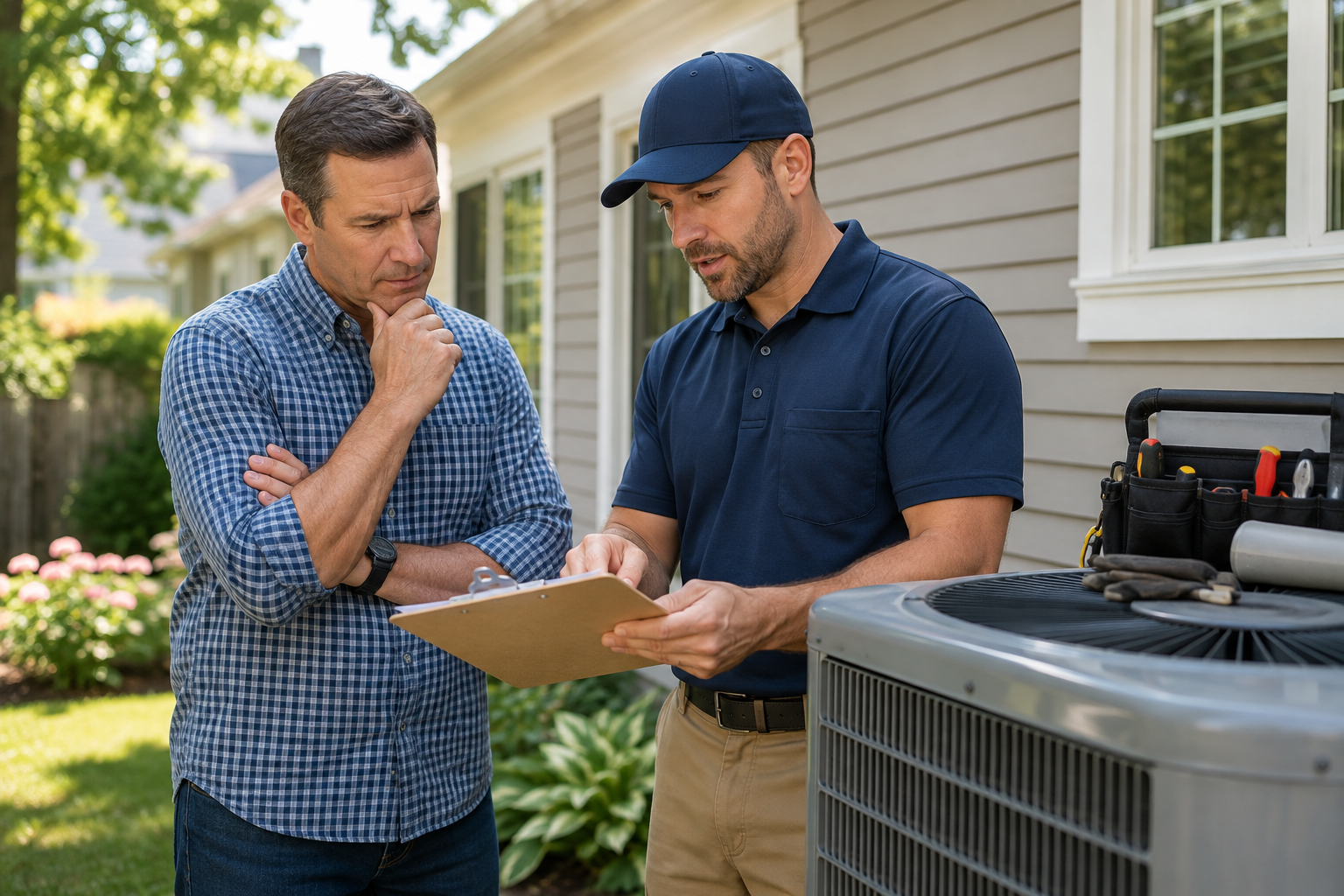
Getting an HVAC repair quote can be frustrating when you don’t know whether the price you’re seeing is reasonable.
A contractor may tell you that a repair will cost hundreds or even thousands of dollars. But the number by itself doesn’t tell you whether you’re getting a fair deal.
The better approach is to understand what failed, what the repair includes, how complicated the job is, and how the quote compares with the condition of your system.
Here’s how to evaluate an HVAC repair estimate before you approve the work.
Don’t judge a repair quote by the total price alone
A repair quote isn’t just a price for a part.
It may include:
- Diagnostic time
- Replacement parts
- Labor
- Refrigerant
- Disposal of old components
- Service fees
- Additional materials
- Emergency or after-hours charges
Two contractors can give you different prices for what appears to be the same repair because their estimates may include different things.
That’s why the first question shouldn’t be:
“Why is your price higher?”
Instead ask:
“What exactly is included in this price?”
What should an HVAC repair quote include?
A useful repair estimate should clearly identify the problem and the work being proposed.
Look for:
- The diagnosed problem
- Parts that need to be repaired or replaced
- Labor
- Materials
- Refrigerant, if applicable
- Any diagnostic or service fee
- Additional charges
- Warranty on the repair
- Total price
The more complicated the repair, the more important a detailed estimate becomes.
If you’re given only a total number with little explanation, ask the contractor to break it down.
Ask what actually failed
Before approving an expensive repair, make sure you understand the diagnosis.
Ask:
What part failed?
What caused it to fail?
Is the part repairable or does it need to be replaced?
Are there other problems with the system?
A good contractor should be able to explain the problem in language you can understand.
You don’t need to become an HVAC technician.
You just need enough information to make an informed decision.
Compare the repair cost with the age of the system
The same repair price can mean very different things depending on the age of your HVAC system.
A significant repair on a relatively new system may be reasonable if the rest of the equipment is in good condition.
The same repair on an older system deserves more thought.
Ask:
- How old is the equipment?
- Has it needed other repairs recently?
- Are additional components showing signs of wear?
- How much longer might the system reasonably last?
- What would replacement cost?
A repair quote should be considered in the context of the entire system, not just today’s problem.
Get a second opinion for expensive repairs
You don’t necessarily need three estimates for every small HVAC repair.
But if you’re facing a large repair bill, getting another professional opinion can be worthwhile.
A second contractor may:
- Confirm the diagnosis
- Recommend a different repair
- Identify another cause
- Explain a different option
- Recommend replacement instead
The goal isn’t necessarily to find the contractor with the lowest price.
The goal is to find out whether the diagnosis and proposed solution make sense.
Be careful with unusually low quotes
A very low estimate can look attractive.
But ask what might be missing.
For example, one contractor might quote only the replacement part while another includes diagnosis, labor, materials, and testing.
Before choosing the cheapest estimate, compare the scope of work.
Ask each contractor:
“Does this price include everything necessary to complete the repair?”
That simple question can prevent an inexpensive quote from becoming an expensive surprise.
Be careful with unusually high quotes too
The opposite can also happen.
A high repair estimate isn’t automatically unreasonable.
Some repairs genuinely require expensive parts, specialized labor, extensive troubleshooting, or difficult access.
But a high quote deserves an explanation.
Ask:
Why does this repair cost this much?
What part is driving the cost?
How much is labor?
Are there additional problems that need to be addressed?
What would replacement cost instead?
You should be able to understand what you’re paying for.
Common reasons HVAC repair quotes vary
Prices can differ because of several factors.
Labor rates
HVAC labor rates vary by location, company, technician experience, and job complexity.
Parts
The replacement part itself can represent a significant portion of the repair cost.
Accessibility
A component that is difficult to reach may take considerably longer to replace than one that is easy to access.
Emergency service
After-hours, weekend, or emergency service may cost more than routine appointments.
System type
Central air conditioners, heat pumps, furnaces, mini-splits, and other systems have different components and repair requirements.
Refrigerant
Refrigerant-related repairs can involve both finding the cause of the problem and correcting it.
Don’t compare two quotes without making sure they’re actually addressing the same problem.
A simple way to compare two HVAC quotes
Suppose you receive these estimates:
| Contractor | Total | Diagnosis | Labor | Parts | Warranty |
|---|---|---|---|---|---|
| A | $650 | Included | Included | Included | 90 days |
| B | $850 | Included | Included | Included | 1 year |
Contractor A is cheaper.
But Contractor B offers a longer repair warranty.
That doesn’t automatically make B the better choice.
Instead, consider the entire package:
What exactly is being repaired?
Are the same parts being used?
Is the labor scope the same?
Are both warranties comparable?
Are there additional charges in either estimate?
This is how you compare quotes intelligently.
When should you question the recommendation?
Pay particular attention when a contractor recommends a major repair or replacement but can’t clearly explain why.
You can ask:
What did you find?
How did you determine that?
What happens if I don’t make this repair?
Is there a temporary or less expensive option?
How long might the system last after this repair?
Would you repair this system if it were your home?
These questions don’t mean you’re accusing the contractor of doing anything wrong.
You’re simply making sure you understand the decision before spending your money.
Repair or replace?
Sometimes the quote itself isn’t the biggest issue.
The bigger question is whether you should repair the system at all.
If the equipment is relatively new and the repair is isolated, repairing it may make sense.
If the system is older, has a history of repeated repairs, and now needs another expensive component, replacement may deserve consideration.
That’s why a repair quote should always be evaluated alongside:
- System age
- Repair history
- Efficiency
- Overall condition
- Expected remaining life
- Replacement cost
A $1,000 repair isn’t automatically a bad deal.
A $300 repair isn’t automatically a good deal.
Context matters.
Questions to ask before approving the work
Before signing off on an HVAC repair, ask:
- What exactly failed?
- What caused the failure?
- What parts are being replaced?
- What does the labor charge include?
- Are there additional fees?
- Is refrigerant included if needed?
- What warranty comes with the repair?
- Are there other problems with the system?
- How long should the repair reasonably last?
- What would replacement cost?
If you don’t understand the answer to one of these questions, ask the contractor to explain it.
You are allowed to understand the work before you approve it.
The Bottom Line
There is no single number that tells you whether an HVAC repair quote is reasonable.
The right question is:
“Is this price reasonable for this particular repair, on this particular system, with this particular scope of work?”
Understand the diagnosis.
Compare what each quote includes.
Consider the age and condition of your equipment.
And when a major amount of money is involved, don’t be afraid to get a second opinion.
Before you approve the repair, understand what you’re paying for.
That’s the Before You Fix approach.

Leave a Reply