
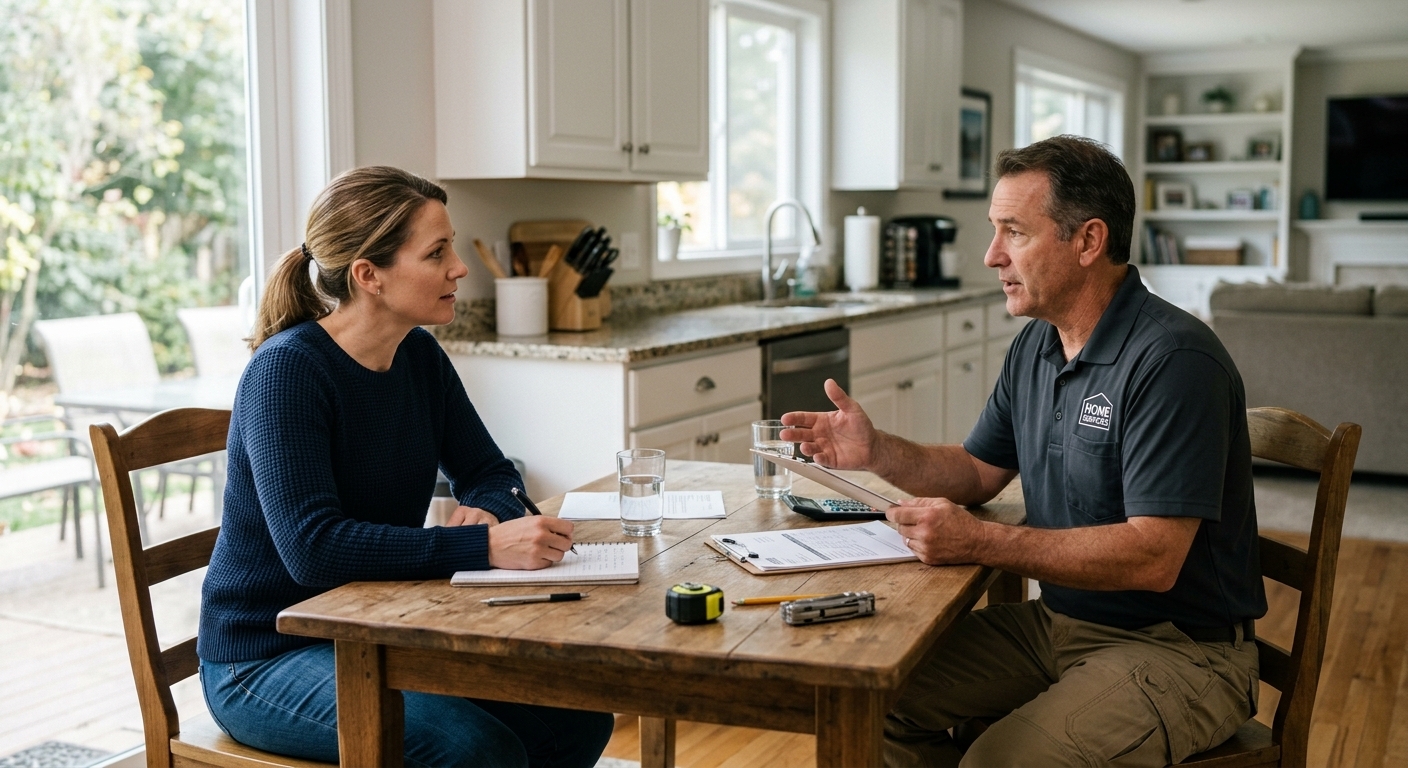
Hiring a contractor is about more than finding someone who can do the work.
You’re also trusting that person with your home, your money, and potentially a significant project.
A good contractor should be willing to explain the work, answer reasonable questions, provide clear documentation, and tell you what to expect before the project begins.
You don’t need to interrogate every contractor you meet.
But for a significant repair or replacement, asking the right questions can help you avoid misunderstandings and make a more confident decision.
1. Are you licensed or registered where required?
Licensing requirements vary depending on the type of work and where you live.
Ask the contractor whether the work requires a license and whether they hold the appropriate credentials.
Don’t assume that every type of home repair requires the same licensing.
For specialized work, verify the requirements that apply to your location and the type of project.
2. Are you insured?
Ask whether the contractor carries appropriate insurance.
Depending on the work, this may include liability coverage and other insurance relevant to their business and employees.
You don’t need to understand every insurance policy provision.
But for substantial projects, you should know that the contractor has appropriate coverage.
3. How long have you been doing this type of work?
Years in business can provide useful context, but experience with your specific type of project matters too.
Ask:
“How much experience do you have with this particular repair?”
Someone may have years of general construction experience but limited experience with a specialized HVAC, roofing, electrical, or plumbing problem.
4. Can you explain exactly what needs to be done?
Before agreeing to the work, make sure you understand the problem.
Ask the contractor to explain:
- What failed
- What caused the problem
- What needs to be repaired
- What parts will be replaced
- Whether additional work may be necessary
- Whether repair or replacement are both options
You don’t need to become an expert.
You simply want to understand what you’re paying for.
5. What happens if you find additional problems?
This is especially important for work that involves opening walls, removing equipment, accessing roofs, or exposing hidden areas.
Ask:
“If you discover something unexpected, how will you handle it?”
Find out whether the contractor will:
- Stop and contact you
- Provide a revised estimate
- Obtain approval before additional work
- Document the change
A clear process can prevent unpleasant surprises.
6. Can I get the estimate in writing?
For significant work, get the important terms in writing.
The estimate or agreement should make it reasonably clear:
- What work is included
- Materials or equipment
- Total price or pricing method
- Payment schedule
- Estimated timeline
- Warranty information
- Major exclusions
The more expensive the project, the more important written documentation becomes.
7. What’s included in the price?
Don’t assume that every contractor’s estimate includes the same services.
Ask whether the price includes:
- Labor
- Materials
- Equipment
- Removal of old equipment
- Disposal
- Cleanup
- Permits
- Inspections
- Additional preparation
Two estimates can have very different prices simply because they include different things.
8. Are permits required?
Some projects require permits or inspections.
Ask:
“Does this project require a permit, and if so, who will handle it?”
Find out whether the permit cost is included in the estimate.
Don’t assume that the contractor or homeowner is automatically responsible.
The requirements depend on the work and local rules.
9. How long will the project take?
Ask for an expected start date and approximate completion time.
Understand that unexpected conditions, weather, material availability, inspections, and other factors can affect the schedule.
For larger projects, ask:
“What could cause the timeline to change?”
That gives you a more realistic expectation than simply asking for a single completion date.
10. What warranty do you provide?
Ask about both the work and the materials.
Find out:
- How long the workmanship is covered
- What parts or materials have manufacturer warranties
- What isn’t covered
- Who handles warranty claims
- Whether there are conditions that could void the warranty
A warranty is only useful if you understand what it actually covers.
11. Can you provide references?
For significant projects, you can ask for references from previous customers.
You can also look for independent reviews and other available information about the contractor.
Don’t rely on a single review or testimonial.
You’re looking for a broader picture of reliability, communication, workmanship, and customer experience.
12. Who will actually do the work?
The person giving you the estimate may not be the person performing the repair.
Ask:
“Who will be doing the work?”
Find out whether the contractor uses employees, subcontractors, or both.
If subcontractors will be involved, ask who is responsible for coordinating and supervising the project.
13. Who will be my point of contact?
Knowing who to contact when you have a question can make a project much easier.
Ask:
“If I have a question during the project, who should I contact?”
For larger jobs, you may have a project manager or another designated contact.
For smaller repairs, it may simply be the contractor.
Either way, you should know who is responsible for communication.
14. What payment schedule do you require?
Understand the payment terms before work begins.
Ask:
- How much is due upfront?
- When are progress payments due?
- When is the final payment due?
- What payment methods are accepted?
- Is financing available?
- Are there additional fees?
For large projects, make sure the payment schedule is clearly documented.
Avoid approving work when you’re unclear about how much you’ll owe and when.
15. Do you offer financing?
If financing is offered, don’t focus only on the monthly payment.
Ask about:
- Interest rate
- Loan term
- Fees
- Total amount paid
- Promotional terms
- What happens if a promotional period ends
A lower monthly payment can still result in a higher total cost.
If financing is involved, compare the total financial obligation, not just the monthly number.
16. What maintenance will the repair require?
A repair or replacement doesn’t necessarily end when the contractor leaves.
Ask:
“What maintenance will this require after installation?”
Understanding maintenance requirements can help you protect your investment and avoid future problems.
This can be particularly useful for HVAC equipment, roofing systems, plumbing components, appliances, and other major home systems.
17. Is repair or replacement the better option?
If you’re dealing with an aging system, ask the contractor to explain both options.
For example:
“If I repair this, how much useful life might I reasonably expect?”
And:
“What would replacement solve that repair wouldn’t?”
You don’t necessarily have to choose the option that the contractor recommends.
The purpose of the question is to understand the trade-offs.
18. What would you do if this were your home?
This can be a useful question when you already understand the basic options.
Ask:
“If this were your home, which option would you choose, and why?”
The answer shouldn’t replace your own research.
But the contractor’s reasoning can reveal useful information about reliability, long-term cost, and risk.
19. Is there anything I should know before we start?
This is an intentionally broad question.
After you’ve discussed the project, ask:
“Is there anything else about this job that you think I should know before we begin?”
Sometimes this prompts a contractor to explain access issues, scheduling concerns, material availability, or other details that didn’t come up earlier.
20. Can we put the final agreement in writing?
Once you’ve decided to hire the contractor, make sure the important terms are documented.
The agreement should reflect the work you’ve actually agreed to.
If the scope or price changes later, ask for those changes to be documented before approving additional work whenever practical.
This protects both sides from misunderstandings.
Watch how the contractor answers
The answers matter.
But how the contractor responds matters too.
Good signs include:
- Clear explanations
- Reasonable questions
- Willingness to provide documentation
- No pressure to decide immediately
- Honest discussion of alternatives
- Clear pricing
- Professional communication
Warning signs can include:
- Refusing to explain the work
- Pressure to sign immediately
- Unclear pricing
- Large unexplained price changes
- Reluctance to provide basic documentation
- Claims that something is an emergency without a clear explanation
One warning sign doesn’t automatically mean a contractor is dishonest.
But several together should make you slow down and investigate further.
You don’t need to ask every question
For a $150 repair, you probably don’t need a twenty-question interview.
For a $15,000 replacement, the situation is different.
Focus your questions on the size and risk of the project.
For a major repair, you should be especially interested in:
Scope → Cost → Qualifications → Warranty → Timeline → Payment → What happens if things change
Those seven areas cover many of the issues that can create problems later.
The bottom line
Hiring a contractor is a financial decision as well as a repair decision.
Don’t be afraid to ask questions.
A good contractor should understand that homeowners want to know what they’re paying for and what to expect.
You don’t need to know everything about construction, plumbing, HVAC, roofing, or electrical work.
You just need enough information to make a reasonable decision.
Before You Fix, ask the questions that help you understand the work before you hire the person doing it.

Leave a Reply