
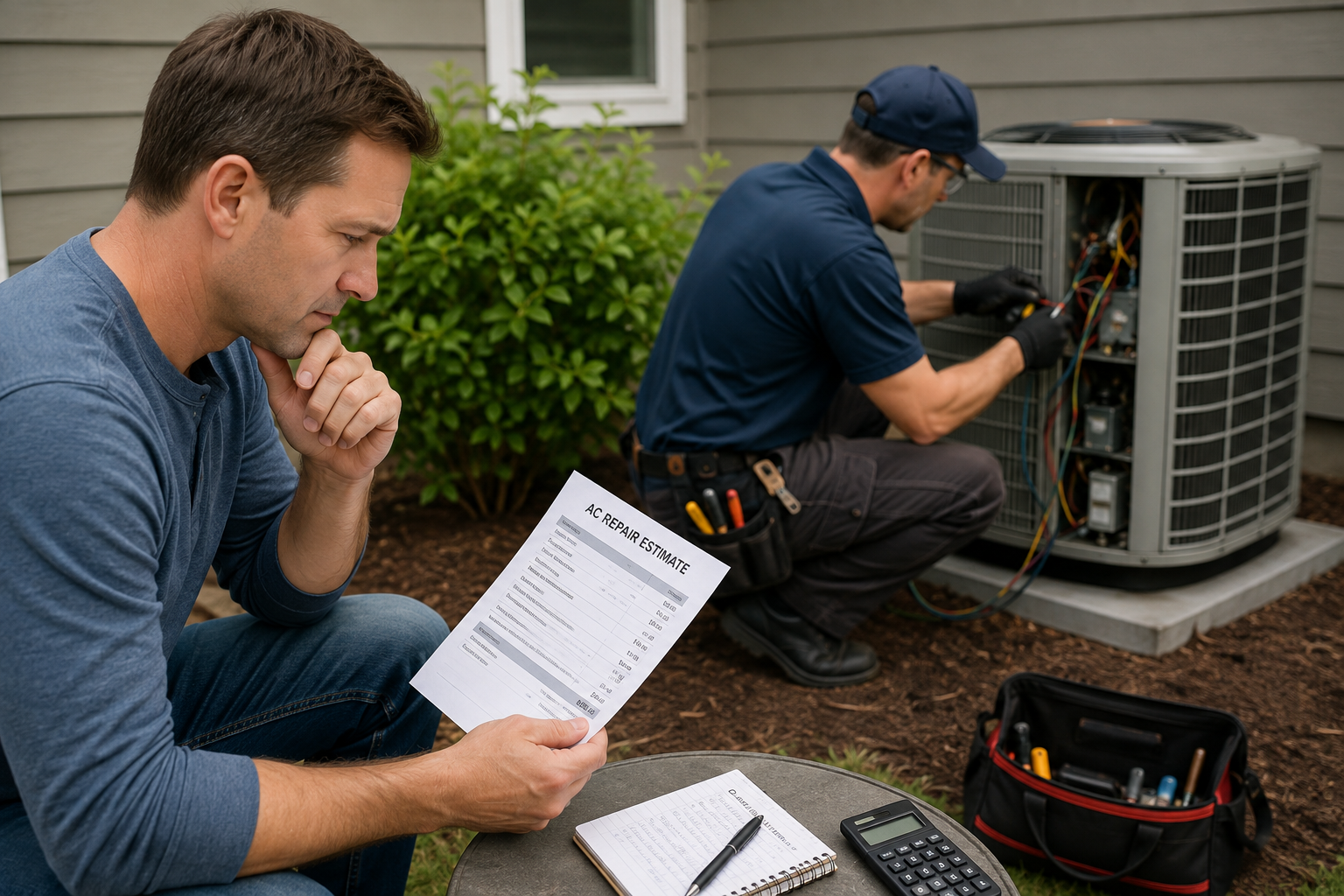
When your air conditioner stops working, the first question is often simple: How much will the repair cost?
According to 2026 industry cost data, most AC repairs run between $150 and $650, with a national average around $350 to $375. Simple electrical fixes — a capacitor or contactor — often stay under $250. Major repairs involving the compressor or refrigerant system can climb to $1,200 to $2,800 or more.
Understanding these numbers is easier when you also know what to ask before hiring the technician giving you the quote. A repair estimate is easier to evaluate when you know what you’re actually paying for.
Typical Cost by Repair Type
Based on 2026 national cost data:
| Repair Type | Typical Cost |
|---|---|
| Capacitor or contactor replacement | $100 – $400 |
| Thermostat repair or replacement | $100 – $300 |
| Refrigerant leak repair and recharge | $200 – $1,600 |
| Fan motor replacement | $250 – $700 |
| Evaporator coil repair | $500 – $2,000 |
| Compressor replacement | $1,200 – $2,800 |
These ranges reflect national averages across multiple 2026 industry sources (Fixr, This Old House, HomeGuide). Actual pricing depends on your system type, local labor rates, and how easily the failed component can be accessed.
AC Repair Cost Estimator
Select what’s wrong to see a realistic cost range. This is a planning estimate, not a quote — always compare it against a real diagnosis and written estimate.
Based on 2026 national cost data. Actual pricing depends on your location, system age, and the technician’s diagnosis — use this range to sanity-check a real quote, not replace one.
Why Has Refrigerant Gotten More Expensive?
If you’re being quoted for a refrigerant leak repair, it’s worth knowing that refrigerant costs have risen significantly due to a federal phaseout of R-410A refrigerant, which has pushed some pricing up 40 to 60 percent in recent years. Older R-22 (Freon) systems are even more expensive to service, since that refrigerant has been phased out entirely and now costs considerably more per pound where it’s still available. If your system uses R-22 and needs a refrigerant recharge, ask directly whether that’s driving the cost, and whether the system’s age makes continued servicing worthwhile.
What Affects the Cost of AC Repair?
Several factors can change the final price of an air conditioner repair.
What failed? — A clogged drain line or faulty capacitor is a relatively inexpensive repair. A failed compressor, major refrigerant leak, or damaged electrical component costs considerably more.
How old is the system? — Repairing an older system may only solve today’s problem. If your AC is relatively new and has otherwise been reliable, repairing it usually makes sense. If it’s older and repairs are becoming frequent, replacement may be the better long-term decision.
What refrigerant does the system use? — As noted above, R-22 systems generally cost more to service than newer R-410A systems.
What are the labor costs? — Many technicians charge a service call or diagnostic fee, often starting around $75, separate from the repair itself.
How old is the system?
Age matters because repairing an older system may only solve today’s problem.
If your AC is relatively new and has otherwise been reliable, repairing it may make sense.
If the system is older and repairs are becoming more frequent, the better financial decision may eventually be replacement.
What refrigerant does the system use?
Refrigerant can affect both repair cost and future serviceability.
Ask the contractor what refrigerant your system uses and whether it is readily available.
Don’t assume that hearing a refrigerant is being phased out automatically means you must replace your entire system.
The actual problem, system condition, repair cost, and available service options all matter.
What are the labor costs?
AC repair isn’t just about the price of the replacement part.
Your estimate may include diagnostic time, labor, materials, refrigerant, disposal fees, or other service charges.
Ask the contractor to explain what is included in the total price.
Common AC repairs can have very different costs
There isn’t one universal price for AC repair.
A relatively simple repair may cost far less than a major component replacement.
For example, these problems can have very different levels of complexity:
- Electrical component failure
- Thermostat problems
- Drain line or condensate problems
- Fan motor problems
- Refrigerant leaks
- Evaporator or condenser coil problems
- Compressor failure
The important point is not memorizing a price for every possible repair.
Instead, understand what you’re being charged for and why.
A written estimate should make the diagnosis, labor, parts, and total cost reasonably clear. See Is My HVAC Repair Quote Reasonable? for a closer look at evaluating what you’re given.
Don’t judge the repair by price alone
Suppose you receive a $700 repair estimate.
Is that expensive?
There isn’t enough information to know.
A $700 repair on a relatively young, reliable system can be very different from a $700 repair on an older system that has already needed several repairs.
Before approving the work, ask:
How old is my system?
What exactly failed?
What caused the failure?
Are there other components showing signs of trouble?
How long should this repair reasonably extend the system’s useful life?
What would replacement cost?
Those answers give you much more useful information than the repair price by itself.
When does an AC repair start to make less sense?
Repair can become harder to justify when several warning signs appear at the same time.
Consider the bigger picture if:
- The system is older.
- Repairs are becoming frequent.
- Major components are beginning to fail.
- Energy costs are increasing.
- The system struggles to maintain comfortable temperatures.
- The repair is expensive relative to the condition of the equipment.
- Replacement is likely to be needed soon anyway.
None of these factors automatically means you should replace the system.
They simply mean the decision deserves more careful consideration.
Get the diagnosis before approving the repair
A good HVAC contractor should be able to explain what failed and why.
Before approving the work, ask for:
- The specific problem that was diagnosed.
- The part or parts that need repair or replacement.
- The cause of the failure, if it can be determined.
- Labor and parts included in the estimate.
- Any additional charges that could apply.
- The expected result of the repair.
- Whether other components are showing signs of failure.
If the explanation is vague, ask questions before authorizing the work.
You’re paying for a repair—not just a replacement part.
When should you get a second opinion?
A second opinion can make sense when the repair is expensive, the diagnosis is unclear, or the contractor is recommending replacement without explaining the reasoning.
This is especially useful when you’re dealing with an older system or a major component failure.
You don’t necessarily need multiple opinions for every minor repair.
But when a large amount of money is involved, comparing the diagnosis and options can help you make a better decision.
How to compare an AC repair with replacement
The best decision isn’t necessarily the option with the lowest upfront price.
Compare:
| Question | Repair | Replacement |
|---|---|---|
| Upfront cost | Usually lower | Usually higher |
| Expected remaining life | Depends on system condition | Typically longer |
| Efficiency | Keeps existing equipment | May provide improved efficiency |
| Risk of another repair | Depends on age and condition | Generally lower initially |
| Long-term cost | Can increase on an aging system | Higher initial investment |
The right question is:
Which option makes the most financial sense for the condition of the system?
That may be repair today.
It may be replacement.
The answer depends on the numbers and the condition of the equipment. See AC Repair vs Replacement: Which Makes More Sense? for a closer breakdown of that comparison.
What should you ask before approving an AC repair?
Before spending money, ask the contractor:
- What exactly failed?
- What caused the failure?
- How old is my AC system?
- What refrigerant does it use?
- What is the total repair cost?
- What does that price include?
- Are there other problems I should know about?
- How long should the repair reasonably last?
- What would replacement cost?
- If this were your home, which option would you choose—and why?
That last question can be useful, but don’t stop there.
Ask the contractor to explain the reasoning behind the recommendation.
The Bottom Line
AC repair costs depend on the problem, the equipment, labor, parts, refrigerant, and the overall condition of the system.
Don’t judge an estimate by the dollar amount alone.
Understand what failed, why it failed, how old the system is, and what you can reasonably expect after the repair.
For a newer, reliable system with an isolated problem, repair may be the sensible choice.
For an older system with repeated or increasingly expensive problems, replacement may deserve serious consideration.
Before you spend the money, understand the problem first.
That’s the Before You Fix approach.

Leave a Reply