
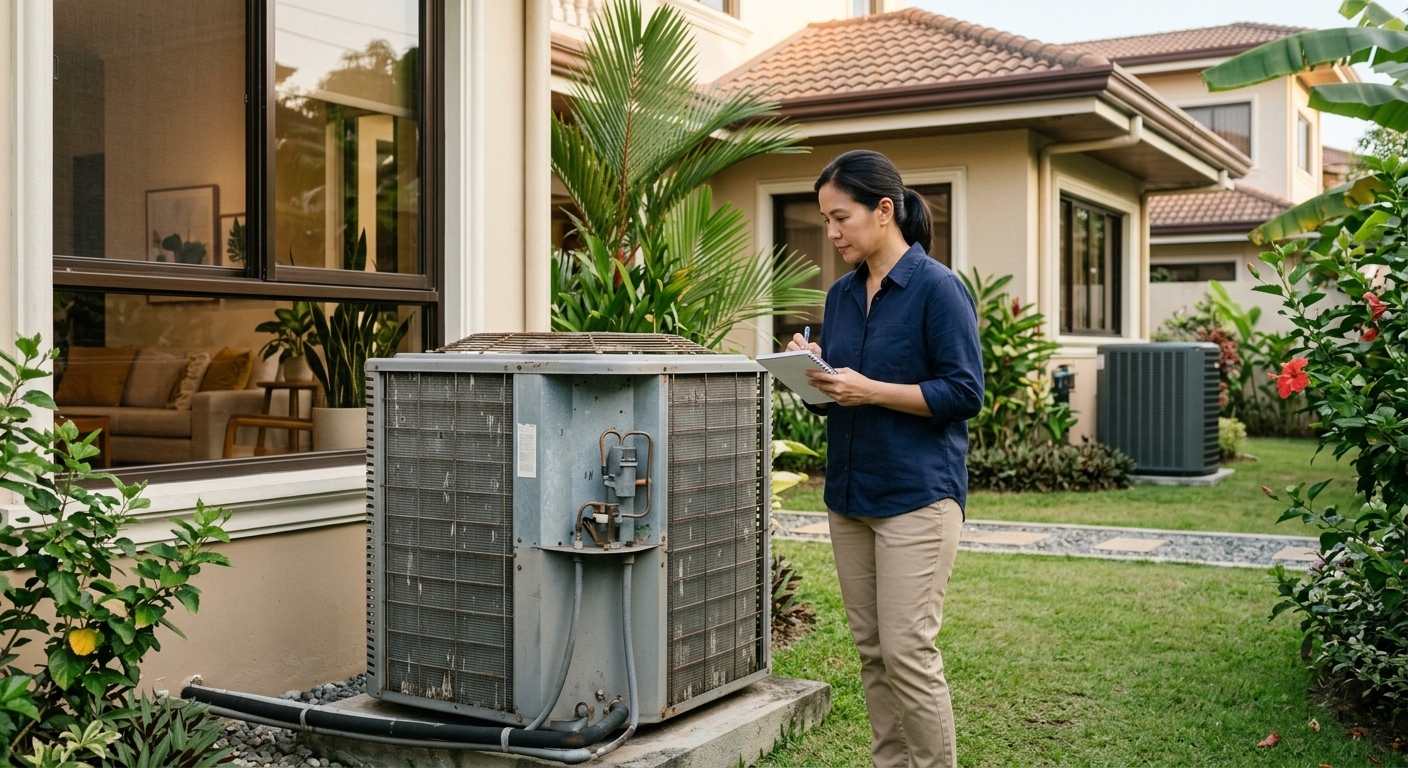
If you’re wondering how long your air conditioner should last, a reasonable expectation for a central AC system is about 15 to 20 years.
That’s a useful planning range—not a guarantee.
Some systems fail earlier, while well-maintained equipment can continue operating beyond 20 years. Climate, installation quality, maintenance, system sizing, operating conditions, and the condition of individual components all affect how long an AC actually lasts. PNNL’s Building America Solution Center, citing ASHRAE service-life data, lists a typical lifespan of about 15–20 years for HVAC equipment, while major manufacturers such as Carrier and Trane give a similar 15–20-year range for air conditioners.
The important question isn’t simply “How old is my AC?”
It’s:
“Is my current AC still worth repairing and operating?”
How long does a central air conditioner last?
A typical central air conditioner can be expected to last roughly:
15–20 years
That’s a useful benchmark for homeowners planning ahead.
But there is a big difference between an AC that is 15 years old and working reliably and one that is 15 years old, frequently breaking down, and struggling to cool the house.
Age is one factor—not the entire decision.
ENERGY STAR recommends considering replacement when an air conditioner or heat pump is more than 10 years old, especially when other warning signs are present, such as frequent repairs or rising energy bills.
That doesn’t mean every 10-year-old AC needs to be replaced.
It means 10 years is a reasonable point to start paying closer attention to the system’s condition and future replacement needs.
Why don’t all air conditioners last the same amount of time?
Two identical-looking air conditioners can have very different lifespans.
Several factors matter.
1. Installation quality
A properly installed system has a better chance of performing reliably over time.
Problems with sizing, airflow, refrigerant charge, ductwork, electrical connections, or installation can affect performance and component life.
A high-quality unit that was poorly installed isn’t necessarily a better long-term investment than a properly installed average unit.
2. Climate
Climate can have a major effect on AC lifespan.
A system that operates for long periods in a hot climate experiences substantially more operating hours than one used only occasionally.
Coastal environments can introduce another challenge because salty, humid air can accelerate corrosion of outdoor equipment.
A U.S. Department of Energy-supported report notes that residential AC lifespan varies with conditions and cites estimates ranging from 8–14 years in coastal and humid areas to around 20 years under more favorable conditions.
That’s one reason a single lifespan number shouldn’t be treated as a guarantee.
3. How much the system runs
An air conditioner that runs heavily year after year accumulates more operating hours than one used lightly.
This doesn’t mean frequent operation automatically destroys an AC.
It simply means the workload matters.
A system in a very hot climate may reach the end of its useful life sooner than an identical system operating under milder conditions.
4. Maintenance
Basic maintenance can help an AC operate properly.
Important maintenance includes:
- Replacing or cleaning filters as appropriate
- Keeping the outdoor unit reasonably clear
- Maintaining proper airflow
- Keeping coils clean
- Addressing drainage problems
- Having problems diagnosed before they become major failures
Maintenance can’t make an AC last forever.
But ignoring obvious problems can shorten the system’s useful life.
5. System sizing
An improperly sized AC can create performance problems.
An oversized system may cool the home very quickly and shut off before adequately removing humidity.
It can also contribute to frequent cycling.
ENERGY STAR notes that oversized units can have shorter lives because frequent short cycling puts additional wear on the compressor.
Proper sizing matters when replacing an old system.
A new AC shouldn’t simply be selected based on the size of the old one.
What happens as an AC gets older?
An older AC doesn’t necessarily stop working suddenly.
Often, performance gradually changes.
You may notice:
- More frequent repairs
- Higher energy bills
- Uneven cooling
- Longer cooling cycles
- More noise
- Difficulty maintaining the thermostat setting
- More frequent refrigerant problems
- Reduced comfort
- Components beginning to fail
One problem by itself doesn’t necessarily mean replacement is necessary.
But several problems occurring together can change the economics of keeping an older system.
Does a 10-year-old AC need to be replaced?
Not necessarily.
A 10-year-old AC can still have plenty of useful life remaining.
ENERGY STAR uses 10 years as an important replacement consideration, but its guidance also points to other factors such as frequent repairs, rising energy bills, humidity problems, and comfort issues.
Consider two hypothetical systems:
AC A:
10 years old, maintained properly, cooling well, no major repairs.
AC B:
10 years old, repeatedly breaking down, increasingly expensive to operate, and struggling to cool the home.
The second system deserves much more serious consideration for replacement.
Age alone doesn’t make the decision.
What about a 15-year-old AC?
At 15 years, you’re entering the range where replacement planning becomes more important.
A 15-year-old system may still operate reliably.
But you should expect that you’re getting closer to the typical service-life range.
If the system needs a major repair at this age, compare the repair cost with the likely remaining useful life.
Also consider whether the system is still providing acceptable comfort and operating costs.
What about a 20-year-old AC?
A 20-year-old central AC is at or beyond the upper end of the commonly cited 15–20-year lifespan range.
That doesn’t mean it will fail tomorrow.
It does mean replacement should be part of your planning.
If the system is working well, you may choose to keep using it.
But waiting until it fails completely can leave you making a rushed replacement decision during the hottest part of the year.
7 signs your AC may be nearing the end
1. Repairs are becoming frequent
One repair doesn’t necessarily mean your AC is finished.
Repeated repairs are different.
If you’re calling for service again and again, the cost and inconvenience may eventually outweigh the benefit of keeping the old system.
2. Energy bills are increasing
An increase in energy costs doesn’t automatically mean the AC is failing.
Electricity rates, weather, thermostat settings, insulation, and other factors can all affect your bill.
But if your energy use or cooling costs are rising while your system’s performance is declining, have the system evaluated.
ENERGY STAR specifically identifies frequent repairs combined with rising energy bills as a reason to consider replacement.
3. Your home isn’t cooling evenly
If some rooms are comfortable while others remain hot, the problem might be the AC.
But it could also involve:
- Ductwork
- Insulation
- Air sealing
- Windows
- Equipment sizing
- Airflow
Don’t automatically replace the AC without determining what’s actually causing the comfort problem.
4. The system is unusually noisy
New or worsening sounds deserve attention.
Grinding, rattling, buzzing, squealing, or other unusual noises can indicate a component problem.
A noise doesn’t automatically mean replacement.
It does mean the system should be evaluated.
5. The AC keeps freezing
Repeated freezing can be caused by airflow restrictions, refrigerant problems, dirty components, or other issues.
A frozen system doesn’t automatically mean it’s old or needs replacement.
But repeated freezing shouldn’t be ignored.
6. The system uses an older refrigerant
Older AC systems may use refrigerants that are being phased out or becoming more difficult and expensive to service.
That doesn’t automatically mean the equipment must be replaced immediately.
But refrigerant availability and repair costs can become part of the repair-versus-replace decision.
7. Major components are failing
A major component failure on a relatively new system can be very different from the same failure on a 17- or 20-year-old system.
That’s where the system’s age becomes important.
Should you repair or replace an old AC?
This is where homeowners can make an expensive mistake.
They see a large repair estimate and immediately assume replacement is better.
Or they keep repairing an aging system because each individual repair seems cheaper than replacement.
Neither approach is automatically correct.
Instead, consider:
Age + repair cost + condition + reliability + operating cost + expected remaining life
For example, a $500 repair on a well-maintained 8-year-old AC may be very different from a $3,500 repair on a 19-year-old system with several other problems.
The numbers need to be evaluated in context.
Ask these questions before replacing it
Before approving an expensive replacement, ask the HVAC contractor:
“What exactly failed?”
Then:
“Can it be repaired?”
Then:
“How much useful life would you reasonably expect if I repair it?”
And finally:
“If this were your home, would you repair or replace it—and why?”
You’re not asking the contractor to make the decision for you.
You’re trying to understand the trade-offs.
Don’t replace an AC based on age alone
This is important.
A 12-year-old AC isn’t automatically bad.
A 15-year-old AC isn’t automatically worthless.
And a 20-year-old AC isn’t guaranteed to fail immediately.
The 15–20-year figure is a planning benchmark, not an expiration date.
The condition of the equipment matters just as much as the number on the calendar.
When should you start planning for replacement?
A good strategy is to start planning before the system becomes an emergency.
If your AC is:
- More than 10 years old
- Requiring frequent repairs
- Becoming less reliable
- Increasing your cooling costs
- Struggling to maintain comfort
start researching your options.
ENERGY STAR specifically recommends considering replacement for equipment over 10 years old when these kinds of performance and repair issues are present.
Planning ahead gives you time to:
- Compare contractors
- Compare equipment
- Get multiple estimates
- Understand installation costs
- Research efficiency
- Consider financing if necessary
- Avoid making a rushed decision
What can you do to help your AC last longer?
You can’t control every factor affecting lifespan, but you can take care of the basics.
Keep airflow healthy
Replace or clean filters according to the manufacturer’s recommendations and household conditions.
Keep the outdoor unit clear
Remove leaves, grass, and other debris that can interfere with airflow.
Address problems early
Don’t ignore unusual noises, repeated freezing, water leaks, or declining performance.
Maintain the system
Follow the manufacturer’s maintenance recommendations and have problems inspected when necessary.
Don’t ignore comfort problems
Uneven cooling or excessive humidity can indicate problems that deserve attention.
The bottom line
A central air conditioner typically lasts about 15–20 years, although actual lifespan varies significantly with climate, installation quality, maintenance, operating conditions, and equipment condition.
At around 10 years, start paying closer attention to performance and repair costs.
At 15 years, replacement planning becomes increasingly sensible.
At 20 years, you’re at the upper end of the commonly cited lifespan range, so a major repair deserves careful comparison against replacement.
But don’t replace an AC simply because it reached a particular birthday.
Before You Fix, look at the age of the system—but make the repair-or-replace decision based on its condition, cost, reliability, and expected remaining life.

Leave a Reply