
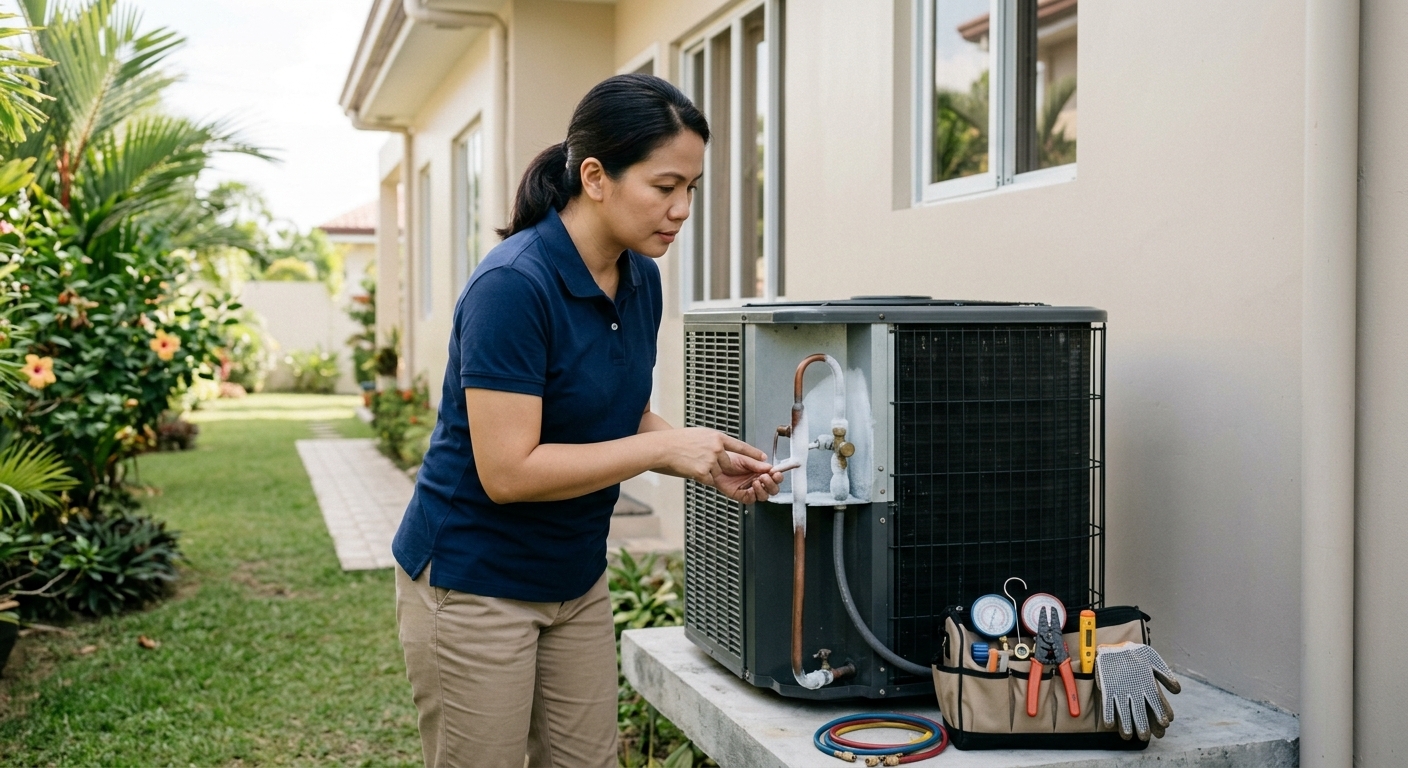
If your air conditioner is covered in ice, your first instinct may be to assume it needs more refrigerant.
Sometimes that’s the cause—but not always.
An AC system can freeze for several different reasons, including restricted airflow, low refrigerant, dirty components, drainage problems, or mechanical issues. Continuing to run a frozen system can make the problem worse.
Here’s what to check first and when it’s time to call an HVAC professional.
Turn the AC off
If you see ice on the indoor evaporator coil, refrigerant lines, or around the outdoor unit, turn off the cooling.
Let the system thaw completely before trying to diagnose the problem.
You can leave the indoor fan running if your thermostat allows it and the system is otherwise safe to operate. This may help circulate air and speed up thawing.
Don’t try to break the ice off with a tool.
You could damage the coil, refrigerant lines, or other components.
Check the air filter
A dirty air filter is one of the simplest things to check.
When the filter becomes heavily clogged, it can restrict airflow across the evaporator coil.
Reduced airflow can cause the coil to become too cold and eventually freeze.
Check the filter and replace it if it is dirty and due for replacement.
Use the filter size and type recommended for your system.
Check your vents
Make sure your supply vents and return-air grilles aren’t blocked.
Furniture, rugs, curtains, or other objects can restrict airflow.
Also check that vents haven’t accidentally been closed.
Your AC needs adequate airflow to operate properly.
If airflow throughout the house seems much weaker than usual, that is an important clue.
Check the indoor airflow
After the system has completely thawed, turn the AC back on and pay attention to the airflow.
Ask:
- Is air coming from the vents?
- Is the airflow weaker than normal?
- Are some rooms receiving less air?
- Does the system freeze again quickly?
If the system freezes again, don’t continue running it repeatedly.
A recurring freeze usually means the underlying problem hasn’t been resolved.
Look for ice on the refrigerant lines
The larger insulated copper line near the outdoor unit may develop ice when the system is experiencing a freezing problem.
Ice on the line is a useful symptom, but it doesn’t tell you exactly what caused the problem.
Possible causes include:
- Restricted airflow
- Low refrigerant
- Dirty evaporator coil
- Mechanical problems
- Other system issues
Don’t assume that adding refrigerant is automatically the solution.
Don’t automatically add refrigerant
Low refrigerant can cause an evaporator coil to become too cold and freeze.
But an air conditioner doesn’t normally consume refrigerant during ordinary operation.
If refrigerant is low, there may be a leak or another problem.
A qualified HVAC technician should diagnose the system and determine whether refrigerant is actually low and why.
Simply adding refrigerant without addressing the underlying issue may only provide a temporary solution.
Check the outdoor condenser
Once the system has thawed, look at the outdoor condenser.
Make sure the area around it isn’t heavily blocked by:
- Leaves
- Grass
- Vegetation
- Debris
The outdoor unit needs adequate airflow to release heat.
Don’t remove electrical panels or attempt repairs inside the condenser.
There can be dangerous electrical components even when the system isn’t actively running.
Check for a dirty coil
A heavily dirty evaporator coil can interfere with airflow and heat transfer.
Unfortunately, the evaporator coil isn’t always easy or safe for a homeowner to access.
If the filter is clean but the system continues to freeze, professional inspection may be necessary.
A technician can determine whether the coil or other components need cleaning.
Look for water after the ice melts
When a frozen AC thaws, some water is expected.
But pay attention to where the water goes.
A clogged condensate drain can cause water to accumulate around the indoor equipment.
Look for:
- Water around the air handler
- A full drain pan
- Water stains
- Dripping from unexpected areas
If there is significant water near electrical equipment, shut the system down and contact a professional.
Consider the weather
An air conditioner can also freeze under certain operating conditions.
Running an AC when outdoor temperatures are unusually low can contribute to freezing.
If you’re using the system during a cool morning or unusually cold weather, check whether your system is designed and configured for those conditions.
What if the AC freezes again?
This is one of the most important clues.
If you thaw the system, replace a dirty filter, and the AC works normally afterward, the filter or airflow restriction may have been contributing to the problem.
But if it freezes again, there may be another issue.
Repeated freezing can point toward:
- Low refrigerant
- Refrigerant leakage
- Airflow problems
- Dirty coils
- Blower problems
- Ductwork restrictions
- Mechanical failures
At that point, professional diagnosis is usually the better choice.
Can you keep running a frozen AC?
It’s generally not a good idea.
Continuing to operate a frozen system can:
- Reduce cooling performance
- Increase operating time
- Restrict airflow
- Cause additional stress on components
- Allow melted ice to create water problems
Turn off cooling and let the system thaw instead of repeatedly switching it on while it’s still frozen.
When should you call an HVAC professional?
Call a qualified HVAC professional if:
- The AC freezes repeatedly
- The filter is clean but freezing continues
- You suspect low refrigerant
- You see significant ice buildup
- The outdoor unit isn’t operating normally
- Airflow remains weak
- There is water around the indoor equipment
- The system makes unusual noises
- You notice electrical problems
- Basic checks don’t solve the problem
If you smell burning, see smoke, or notice exposed or damaged electrical wiring, turn the system off and address the safety issue immediately.
What information should you give the technician?
Before the technician arrives, make a few notes.
Tell them:
- Where the ice appeared
- How much ice you saw
- How long the system had been running
- Whether the filter was dirty
- Whether airflow seemed weak
- Whether the problem has happened before
- Whether you noticed water after thawing
- Whether the outdoor unit was operating normally
These details can help the technician narrow down the possible causes.
Repair or replacement?
An AC freezing problem doesn’t automatically mean the system needs to be replaced.
If the cause is a dirty filter, airflow restriction, or another relatively simple issue, repair may be all that’s needed.
If the system is older and has a significant refrigerant leak, compressor problem, or repeated failures, replacement may deserve consideration.
Ask the technician:
“What caused the system to freeze?”
Then ask:
“Is this a repair that makes sense for the age and condition of the system?”
Those answers are more useful than simply knowing the price of the repair.
The bottom line
A frozen AC isn’t something you should ignore.
Start by turning off the cooling and allowing the system to thaw. Then check the filter, vents, airflow, and outdoor unit.
If the system freezes again—or if you suspect refrigerant, electrical, mechanical, or other complex problems—call a qualified HVAC professional.
Don’t assume that every frozen AC needs refrigerant, and don’t keep running a system that repeatedly freezes.
Before You Fix, find out why your AC is freezing before paying for the repair.

Leave a Reply