
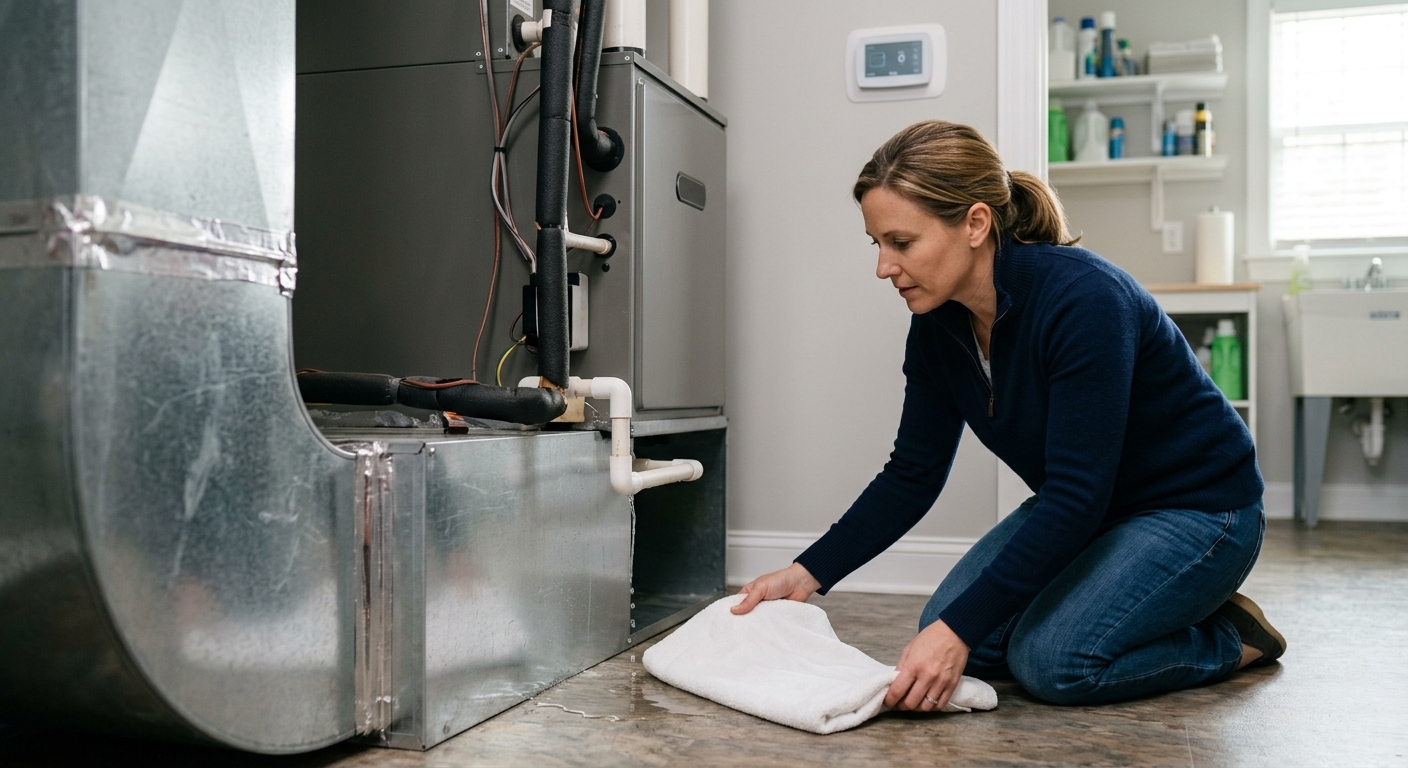
Finding water around your air conditioner can be alarming, especially if it’s dripping from the indoor unit or leaving a wet spot on the floor.
The good news is that an AC leaking water inside doesn’t always mean the system needs an expensive repair.
A clogged drain, dirty filter, frozen coil, or drainage problem can all cause water to appear where it shouldn’t. Some causes, however, require professional attention.
Here’s what to check first.
Turn the AC off
If water is actively leaking from the indoor unit, turn off the cooling system.
Continuing to run it can allow more condensation to accumulate and potentially cause additional water damage.
If your thermostat has a Fan setting, you may be able to run the indoor fan after turning cooling off, but only if there is no significant water around electrical components.
If you’re unsure, leave the system off until it can be inspected.
Find where the water is coming from
Try to identify the general location of the leak.
Water might appear:
- Under the indoor air handler
- Around the furnace or evaporator coil
- From a ceiling vent or nearby ceiling
- Around a condensate drain
- From a drain pan
- Along the wall or floor near the HVAC equipment
The location can provide an important clue.
Water appearing several feet away from the equipment may have traveled along a ceiling, wall, or other surface.
Check the air filter
A dirty air filter can restrict airflow through the system.
Restricted airflow can cause the evaporator coil to become unusually cold and potentially freeze.
When the ice eventually melts, the resulting water can overwhelm the normal drainage system.
Check the filter and replace it if it’s visibly dirty and due for replacement.
Use the size and type recommended for your system.
Look for ice
After turning the AC off, check for visible ice around accessible refrigerant lines or the indoor equipment.
If you see ice, allow it to thaw naturally.
Don’t chip or scrape the ice away with a tool.
A frozen AC can result from:
- Restricted airflow
- Low refrigerant
- Dirty coils
- Blower problems
- Other mechanical issues
If the system repeatedly freezes, it needs professional diagnosis.
Check the condensate drain
Air conditioners naturally produce condensation while cooling your home.
That water normally flows into a drain pan and through a condensate drain.
If the drain becomes clogged, water can back up and eventually leak indoors.
You may see:
- Water in or around the drain pan
- A slow-draining condensate line
- Water around the indoor unit
- A secondary drain overflowing
A clogged condensate drain is a common reason for indoor AC water leaks.
Don’t assume you should clean the drain yourself
Some homeowners use a simple drain-cleaning procedure, but the appropriate method depends on the system and how the drain is configured.
If you aren’t familiar with your HVAC system, don’t disconnect components or pour chemicals into the drain.
Improper cleaning can damage equipment or fail to address the actual problem.
If the drain is inaccessible, repeatedly clogs, or you’re unsure what you’re looking at, call an HVAC professional.
Check the drain pan
If you can safely see the condensate drain pan, look for standing water.
A small amount of condensation during operation can be normal.
But a pan that is full of water suggests that the drainage system isn’t keeping up.
An older or damaged drain pan can also crack and leak.
Replacing a damaged pan may require access to the indoor coil assembly, so this is often a job for a professional.
Check for a clogged condensate line
The condensate line carries water away from the indoor equipment.
Over time, algae, dirt, or other debris can restrict the line.
If the line becomes blocked, water can back up into the pan or surrounding area.
Some systems have a secondary drain or float switch designed to help prevent overflow.
If that safety system activates, the AC may stop operating.
Check whether the system recently froze
Think back to whether you’ve recently noticed:
- Ice on the refrigerant line
- Weak airflow
- An unusually long cooling cycle
- An AC that wasn’t cooling properly
If the answer is yes, the water leak may be related to a frozen evaporator coil.
When the ice melts, a large amount of water can enter the drain pan at once.
If freezing keeps happening, don’t simply keep thawing the system and restarting it.
The underlying cause needs to be identified.
Look for a blocked or damaged drain
If the drain line is accessible, look for obvious signs of blockage or damage.
But don’t dismantle the HVAC system to get to it.
A professional may need to inspect:
- The primary drain
- Secondary drain
- Drain pan
- Float switch
- Evaporator coil
- Condensate pump
These components work together to remove the water produced by your AC.
What if water is coming through the ceiling?
If your indoor HVAC equipment is located in an attic or another area above the living space, a clogged drain can allow water to overflow and eventually appear through the ceiling.
This deserves prompt attention.
Water can damage:
- Drywall
- Insulation
- Wood framing
- Flooring
- Electrical components
If water is actively entering the living area, turn off the AC and address the leak before continuing to operate the system.
What if the condensate pump isn’t working?
Some HVAC systems use a condensate pump when gravity drainage isn’t practical.
The pump moves condensation away from the equipment.
If the pump fails, water may accumulate and eventually leak.
Signs of a possible condensate pump problem include:
- Water collecting near the pump
- The pump not activating
- A full reservoir
- The AC shutting off unexpectedly
If you’re unfamiliar with the pump’s operation, have a technician inspect it.
Check whether the AC is still cooling
An indoor water leak accompanied by poor cooling can provide another clue.
If the system is leaking water and blowing warm air or struggling to cool the home, the problem may involve freezing, refrigerant, airflow, or another HVAC issue.
If it’s cooling normally but water is leaking, a drainage problem may be more likely.
Neither symptom alone provides a diagnosis, but the combination can help a technician narrow down the possibilities.
Don’t ignore repeated leaks
A leak that disappears after a simple drain blockage is cleared may be resolved.
But if the problem keeps returning, don’t treat it as normal.
Repeated water leaks can indicate:
- A recurring drain blockage
- A damaged drain pan
- Improper drainage
- A condensate pump problem
- A frozen coil
- Airflow problems
- Refrigerant issues
- Equipment or installation problems
A recurring leak deserves a proper diagnosis.
When should you call an HVAC professional?
Call a qualified HVAC professional if:
- Water continues leaking after the system is turned off
- The leak returns after a basic fix
- The AC keeps freezing
- You suspect low refrigerant
- The drain pan is damaged
- The condensate pump isn’t working
- Water is reaching electrical equipment
- Water is coming through a ceiling
- The system isn’t cooling properly
- You can’t identify the source of the leak
If significant water is near electrical equipment, prioritize safety and don’t handle electrical components yourself.
What should you do about the water?
While you’re waiting for the problem to be addressed, protect the surrounding area.
Depending on the situation:
- Place a container under the drip
- Use towels to absorb standing water
- Move valuables away from the area
- Protect flooring if necessary
- Monitor for continued water intrusion
Don’t allow a manageable leak to become a larger water-damage problem.
If drywall, flooring, or other building materials remain wet, they may require separate attention after the HVAC problem is resolved.
Repair or replacement?
An AC leaking water doesn’t automatically mean the entire system needs to be replaced.
A clogged drain, dirty filter, or damaged drain pan may be a relatively straightforward repair.
Even a frozen coil doesn’t necessarily mean the equipment is at the end of its life.
If the system is older and has repeated problems, however, replacement may eventually make more financial sense.
Ask the technician:
“What is causing the leak?”
Then ask:
“Is this an isolated repair, or is it a sign of a larger problem with the system?”
Those questions can help you decide what to do next.
The bottom line
An AC leaking water inside your home is something you should address rather than ignore.
Start by turning off the cooling, protecting the area from water damage, and checking simple things such as the air filter and visible drainage problems.
If you see ice, repeated leaks, significant water, electrical concerns, or evidence of a more complicated HVAC problem, call a qualified professional.
The important thing isn’t just stopping the water.
It’s finding out why the water is getting where it shouldn’t.
Before You Fix, find the source of the leak before paying for a repair—or replacing the entire system.

Leave a Reply